
India China BrahMos missile belt strategy
BrahMos, the fastest cruise missile of its class, has generated renewed interest after its heroics during last year's Operation Sindoor. Its precision and long, range capabilities were on show as India struck Pakistani air bases during the hostilities, forcing Islamabad to seek a ceasefire.
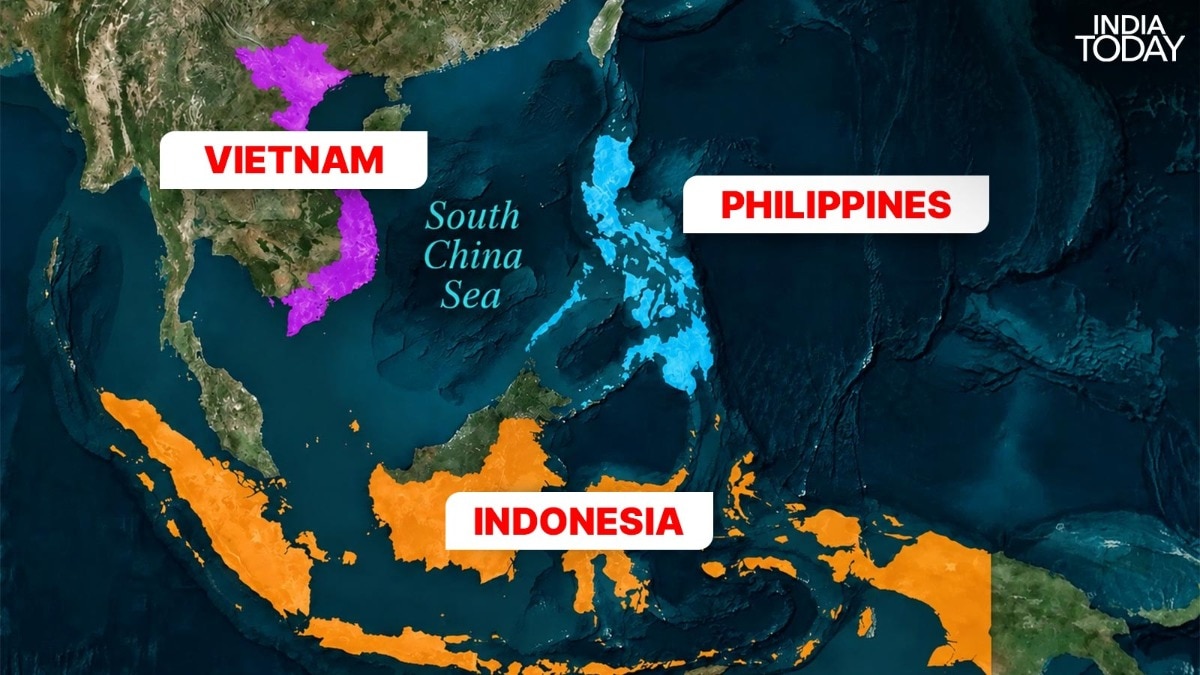
Over the past year, Vietnam and Indonesia have signed deals with India for the BrahMos. Malaysia and Thailand could be next. In 2022, the Philippines was the first country to buy the BrahMos for coastal defence in a massive $375 million deal. All these countries encircle the disputed South China Sea, where they face a hostile and increasingly aggressive Beijing.
Lt General PR Shankar, who was closely involved in the missile's induction and development, underlined that the BrahMos belt strategy would not affect India, China ties. However, it would definitely make China aware of the fact that it is "dealing with a stronger India", he said.
"A whole regional signalling is going on. China needs to read the writing on the wall," Lt General PR Shankar said in the interview, titled 'BrahMos spreads across South China Sea'.
"China has seen how the BrahMos works. In the South China Sea, China is operating at maximum extended range. And as it keeps extending the range, it comes into the arc of the Philippines, Vietnam, Indonesia. Thus, China becomes vulnerable," he further said.
Tristan Tang, co, founder of Taiwan Defence Studies Initiative, underlined that the BrahMos would act as a deterrent to possible Chinese amphibious operations.
"ASEAN is not an Asian NATO, but with exports from India and better coordination, it can have a BrahMos belt," Tang said. WHAT IS THE 'BRAHMOS BELT'?
The development has shifted focus to what India may be quietly building: a BrahMos belt.
It does not, however, refer to any formal military alliance. The term has been used by experts to loosely refer to India's growing network of BrahMos partnerships with countries that have maritime disputes or strategic concerns involving China.
At the heart of the dispute lies the South China Sea, a major shipping route that accounts for 21% of global trade.
Now, China claims about 90% of the South China Sea through its "nine, dash line", creating overlapping territorial disputes with Vietnam, the Philippines, Malaysia, Brunei, and Taiwan. Over the years, China has sought to assert its claim by building islands and conducting naval patrols. This has led to standoffs with the Philippines (2012) and Vietnam (1974, 1988).
However, confronting a large power like China brought its own set of challenges for these smaller Southeast Asian nations. The key challenge has been their inability to threaten Chinese vessels operating in disputed areas.
With more Southeast Asian nations now acquiring the BrahMos anti, ship missiles, the scenario has started to change. The deal with Vietnam is around Rs 5,900 crore, while Indonesia has decided to acquire two BrahMos batteries worth Rs 1,900 crore.
If more nations like Thailand go on to acquire the missile, the result will be a chain of BrahMos batteries positioned around some of Asia's most strategically sensitive waters.
Experts have viewed it as a shrewd move by India, raising China's hackles without sending a soldier or ship to the South China Sea. The BrahMos missile system on show during the 78th Army Day parade (PTI) WHAT MAKES THE BRAHMOS SIGNIFICANT?
Notably, the BrahMos missile is particularly suited for this role. With a flight range of up to 290 km, the 'fire, and, forget' missile can be launched from land, ship or fighter aircraft.
"BrahMos is very fast and accurate, and you virtually cannot intercept it. It was the one that caused maximum damage at Pakistani air bases like Nur Khan, Sargodha and Murid. BrahMos was a game changer for us. No air defence system in China can intercept the BrahMos," Lt General PR Shankar said.
This will make China cautious. Much of China's maritime strategy depends on deploying large naval platforms across disputed waters. BrahMos's speed and precision pose a significant threat to such vessels, which can force China to remain far from contested areas.
An article in China's mouthpiece, Global Times, in 2024 laid bare Beijing's concerns. It mentioned how the acquisition of the BrahMos by the Philippines could give it striking capability towards reefs and regions in the disputed Spratly Islands. The BrahMos missile can be launched from land, ship or fighter aircraft WHY CHINA COULD BE CONCERNED
Against this backdrop, two waterways are particularly significant for China, the Malacca Strait and the Luzon Strait.